Model Hardware Standard: An AI Tool Connecting AI Agents with Physical Hardware
Model Hardware Standard is an emerging AI tool focused on an important challenge in the development of physical AI: helping AI Agents discover, understand, and interact with real-world hardware in a more consistent way. As AI moves beyond chatbots and software automation into robotics, edge devices, laboratory equipment, and other physical systems, a standardized way for AI models and agents to communicate with hardware becomes increasingly valuable.
The core concept behind Model Hardware Standard can be understood through a simple workflow: Model → Agent → Hardware. The AI model interprets goals, context, and constraints; the AI Agent plans actions and selects the appropriate tools; and the physical hardware senses and performs actions within its physical limitations. Model Hardware Standard aims to make the connection between AI Agents and physical devices more consistent and understandable.
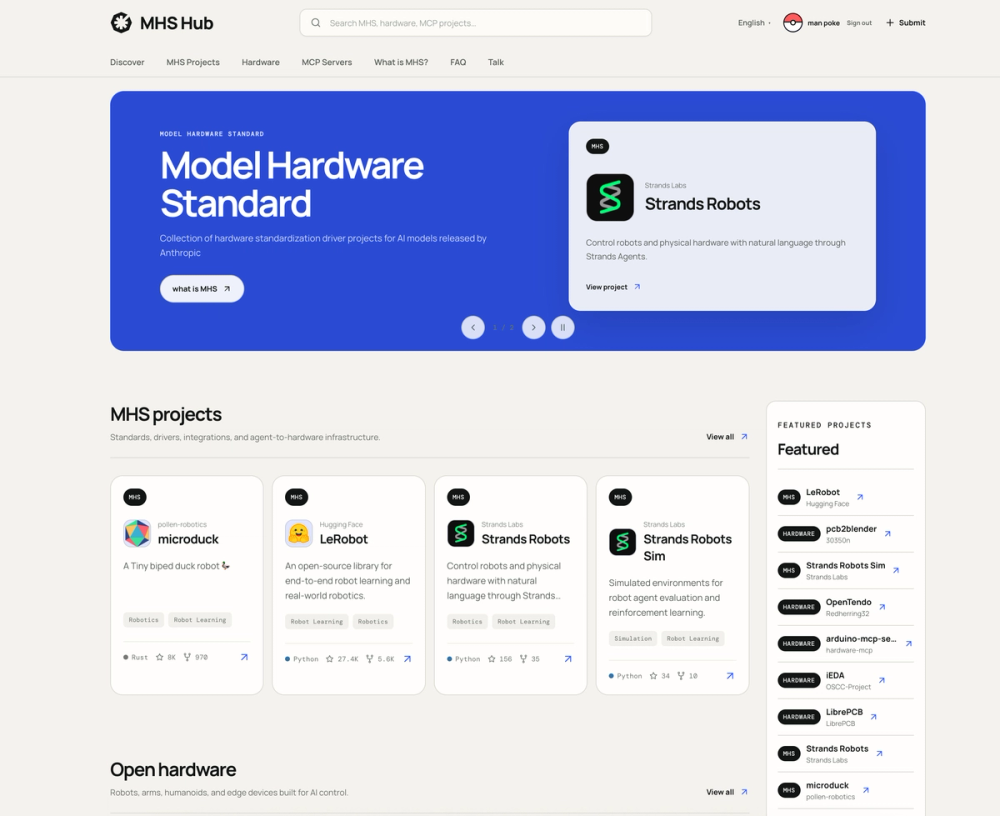
One of the key features of this AI tool is its focus on hardware standardization and agent-to-hardware infrastructure. Instead of treating every robot or device as a completely different integration problem, MHS proposes a shared approach for describing physical equipment, operations, device states, capabilities, and safety considerations. This can potentially make it easier for developers to build AI Agents that interact with different types of physical systems.
The Model Hardware Standard ecosystem also provides a convenient way to discover related projects. Its directory includes MHS projects, open hardware, robotics projects, and MCP Servers. Current examples include LeRobot, Strands Robots, Strands Robots Sim, Microduck, and various open hardware and robotics projects. The hardware section covers robots, robotic arms, humanoids, and edge devices designed for AI control.
Another important part of the ecosystem is MCP (Model Context Protocol). While MCP is primarily designed to connect models and AI Agents with software tools and data, MHS focuses more specifically on physical devices, including their capabilities, operations, states, and safety requirements. An MCP server can also expose a hardware driver or hardware API as tools that an AI Agent can call, creating a potential bridge between software-based agent workflows and physical hardware.
For developers exploring AI Agents, robotics, physical AI, open-source hardware, or agent-based automation, Model Hardware Standard offers an interesting collection of projects and concepts to explore. The platform makes it easier to discover hardware projects with AI integration paths while providing a clearer picture of how models, agents, MCP, and physical devices can work together.
It is important to note that the core MHS specification is currently described as a limited research preview, rather than a mature, fully open standard. The MHS Hub itself is an independent directory and states that it is not affiliated with Anthropic.
Overall, Model Hardware Standard represents an interesting direction for the evolution of AI tools and AI Agents. As intelligent agents increasingly move from digital environments into the physical world, standards that help AI understand and operate hardware could become an important part of the emerging physical AI ecosystem. For anyone researching AI Agents, robotics, MCP, AI hardware, or agent-to-hardware integration, MHS provides a useful starting point for discovering projects and understanding this developing technology landscape.