Firecrawl Introduction
Firecrawl is a web scraping and crawling service designed for AI applications. It transforms websites into clean, LLM-ready data, allowing users to extract structured information using large language models (LLMs). Firecrawl provides an API and SDKs in Python, Node, Go, and Rust, making it easy to integrate into various applications. It is particularly suited for business websites, documentation, and help centers.
Firecrawl Features
Core Functionalities
Firecrawl offers several key functions:
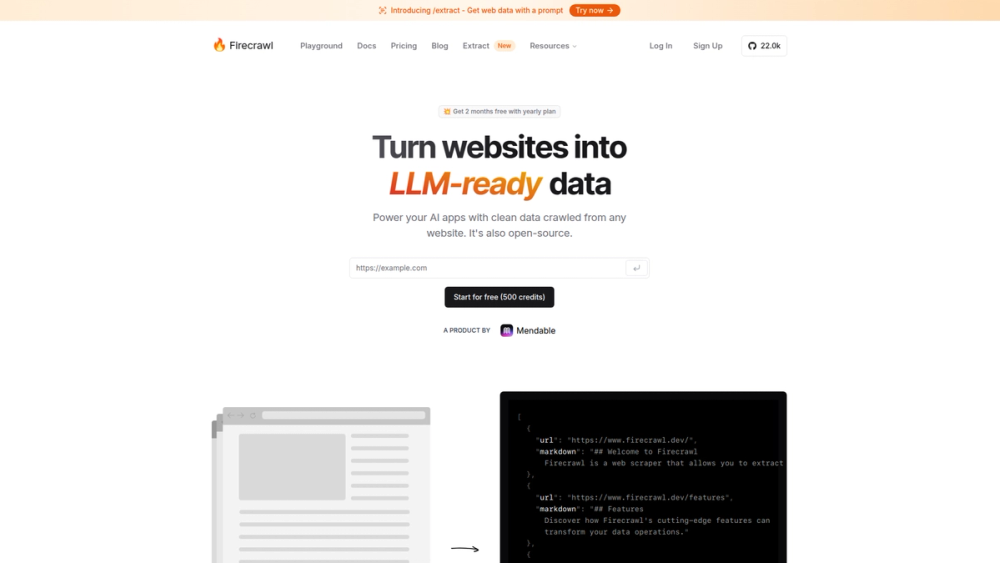
- Scrape: Extracts content from a URL in formats like markdown, structured data (using LLM extraction), screenshots, and HTML.
- Crawl: Crawls all accessible URLs of a website and returns content in a format ready for LLMs.
- Map: Quickly retrieves all URLs from an input website.
- Extract: Uses AI to extract structured data from individual pages, multiple pages, or entire websites.
LLM and Data Handling
- LLM Extraction: Supports Pydantic models in Python and zod models in Node.js for defining data structures to be extracted.
- Actions: Allows users to perform actions on a web page before extracting data, such as scrolling or interacting with dynamic content.
- Data Formatting: Returns clean, well-formatted markdown, structured data, or other specified formats suitable for LLM applications.
- No Caching: By default, Firecrawl does not cache content, ensuring users always get the latest data.
Technical Capabilities
- Dynamic Content Handling: Can handle dynamic content rendered with JavaScript, ensuring comprehensive data collection.
- Smart Wait: Intelligently waits for content to load, making scraping faster and more reliable.
- Reliability: Focuses on reliable data delivery, designed to navigate common web scraping challenges like rate limits and anti-bot mechanisms.
- Media Parsing: Can parse and output clean content from web-hosted PDFs, DOCX files, images, and more.
Integrations and Development
- Integrations: Fully integrated with tools and workflows like LlamaIndex, Langchain, Dify, Flowise, CrewAI, and Camel AI.
- Open-Source: Developed transparently and collaboratively, with a GitHub repository available.
- Hosted and Self-Hosted: Offers a hosted version with proprietary scraping technology and a self-hosted option under the AGPL-3.0 license.
Pricing and Scaling
- Flexible Pricing: Offers a free plan to start, with options to scale through monthly or yearly subscriptions.
- Add-ons: Provides options for auto-recharge credits and credit packs for additional monthly credits.
- Enterprise Plan: Offers unlimited credits, custom RPMs, and top-priority support for large-scale projects.
Firecrawl Frequently Asked Questions
General
- What is Firecrawl? Firecrawl is a web scraping and crawling API that turns websites into clean, LLM-ready markdown or structured data, designed for AI companies.
- What sites work? Best suited for business websites, docs, and help centers, but it does not support social media platforms.
- Who can benefit from using Firecrawl? Ideal for LLM engineers, data scientists, AI researchers, and developers needing web data for training models, market research, and content aggregation.
- Is Firecrawl open-source? Yes, the repository is on GitHub, but it is still in the early stages of development.
- What is the difference between Firecrawl and other web scrapers? Firecrawl is designed with reliability and AI-ready data in mind, focusing on delivering clean data for LLM applications.
- What is the difference between the open-source version and the hosted version? The hosted version includes Fire-engine, a proprietary scraper handling proxies, anti-bot measures, and actions, along with a dashboard for analytics.
Scraping & Crawling
- How does Firecrawl handle dynamic content on websites? It handles dynamic content rendered with JavaScript, ensuring comprehensive data collection.
- Why is it not crawling all the pages? Reasons can include rate limiting and anti-scraping mechanisms. Users can contact support for assistance.
- Can Firecrawl crawl websites without a sitemap? Yes, it can crawl all accessible subpages even without a sitemap.
- What formats can Firecrawl convert web data into? Primarily converts web data into clean, well-formatted markdown.
- How does Firecrawl ensure the cleanliness of the data? It uses advanced algorithms to clean and structure data, removing unnecessary elements.
- Is Firecrawl suitable for large-scale data scraping projects? Yes, it offers various plans, including a Scale plan for scraping millions of pages.
- Does it respect robots.txt? Yes, Firecrawl respects the rules set in a website's robots.txt file.
- What measures does Firecrawl take to handle web scraping challenges like rate limits and caching? It manages requests intelligently with stealth proxies, rate limits, and smart wait techniques.
- Does Firecrawl handle captcha or authentication? It attempts to solve captchas automatically, but this is not always possible. Authentication can be handled by providing auth headers to the API.
API Related
- Where can I find my API key? API keys can be found in the dashboard under API Keys.
Billing
- Is Firecrawl free? It is free for the first 500 scraped pages, after which users can upgrade to paid plans.
- Is there a pay per use plan instead of monthly? Currently, there is no pay-per-use plan; users can upgrade to Standard or Growth plans for more credits and higher rate limits.
- How many credits does scraping, crawling, and extraction cost? Scraping and crawling each cost 1 credit per page; extraction costs vary.
- Do you charge for failed requests (scrape, crawl, extract)? No, failed requests are not charged.
- What payment methods do you accept? Payments are accepted through Stripe, which supports most major credit cards, debit cards, and PayPal.